Organisation of Islamic Cooperation
The Collective Voice of The Muslim World
Date: 24/09/2010
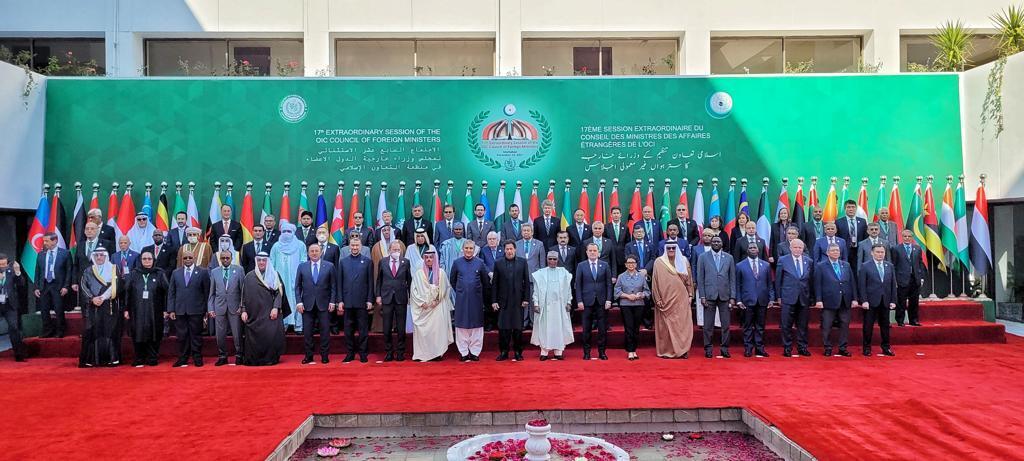
United Nations Headquarters New York 24 September 2010 Honourable Ministers, Excellencies, Ladies and Gentlemen, It is a great honour for me to welcome you to the Annual Coordination Meeting of the Foreign Ministers of the OIC Member States. Allow me at the outset to express our sincere thanks and gratitude to the Republic of Tajikistan for having successfully hosted and organized the 37th Session of the OIC Council of Ministers in Dushanbe last May. Major decisions and resolutions were adopted during that Session that have enhanced our joint actions. We look forward to the leadership of Tajikistan to continue its endeavours aimed at serving the Muslim Ummah, and to consolidate the bonds of solidarity and cooperation among the Members of Muslim world family. We believe that the Dushanbe meeting was a prelude for a more active role in the Muslim world’s affairs on the part of the OIC Member States from Central Asia. Next year the 38th OIC Council of Ministers will be hosted in Astana, the capital of the Republic of Kazakhstan, where we will also benefit from the active role Kazakhstan plays on the world’s scene. Honourable Ministers, Excellencies, Before going any further allow me to go directly to an issue that preoccupies us all, and that calls for our immediate attention and action. As you are all aware Pakistan is struggling to cope with its worst-ever natural disaster. Monsoons catastrophic flooding submerged a very large area throughout the country, and ruined almost four million hectares of Pakistan’s rich farmland. Around 20 million persons got affected by this calamity, many millions are now homeless. The perspective for the future looks very depressing. There are reports indicating that this ordeal might trigger the total collapse of the Pakistani economy that has already registered a loss of about 43 billion dollar. Moreover the farmers would not be able to use their farmland soon, and the country stands facing a triple threat to food supplies, with seeds, crops and income hit and destroyed. As a result, Pakistan is in dire need for a colossal humanitarian rescue operation of unprecedented scale. Since the first day of this disaster, I took many measures to mobilize support and to sensitize the public opinion in the member states to the extreme gravity of this disaster. I visited Pakistan along with an OIC delegation and co-organised with the Pakistani government an emergency meeting of the humanitarian organizations of the OIC member states in Islamabad on 29 August 2010. The participating delegations pledged approximately U.S. 1 billion dollars, which include 700 million to be re-allocated by the IDB for reconstruction projects of the flood affected areas. I would like to thank all OIC member states that participated in these efforts, with a special thanks and appreciations to the Kingdom of Saudi Arabia whose contribution topped the list of donors from both the Islamic world and international community. Given the persisting precarious situation in the floods affected areas in Pakistan I would like to appeal to you to kindly continue your generous assistance to Pakistan as reconstruction effort and the effect of this disaster will continue to inflict the people of Pakistan for a long time to come. Honourable Ministers, Excellencies, Ladies and Gentlemen, As we assemble today, to discuss and coordinate our viewpoints regarding the topics inscribed on the UN General Assembly’s agenda, we realize that pertinent issues affecting the Muslim world have not registered much change or progress. At the political level, and as customary, the issues of Palestine, Iraq, Jammu and Kashmir, Somalia, Bosnia- Herzegovina, Sierra Leone, are traditionally addressed by a special OIC Contact Groups composed from a number of OIC member states. Every Contact Groups prepares a report on its deliberations and addressed it to your meeting. As for Afghanistan, I would like to update you on the developments that happened since Dushanbe meeting. We are about to open an OIC Office in cooperation with Afghanistan and with the support of the United Arab Emirates. Excellencies, Ladies and Gentlemen, Major international decisions are debated and adopted here at the premise of the United Nations forum. Given the sheer number of the OIC countries we realize that we certainly have the means and the leverage to influence the voting patterns in many domains. I think that it is about time that we should use this voting power rationally. I have received demands from a number of our Member States insisting that solidarity in voting on core issues of importance to the Muslim world is very critical and should be adhered to and that any dissenting vote should be looked at very seriously. At this critical juncture, it is imperative to heed the plea issued a few weeks ago by your meeting in Dushanbe on this very issue, and contained in resolution No. 41/37-Pol. Operative Para One of this resolution reads as follows: “Reaffirms the priority need to enhance cooperation and coordination among Member States at the United Nations and other international and multilateral fora with a view towards adopting unified positions and voting patterns with respect to resolutions submitted on behalf of the OIC or towards which the OIC has a common position, so as to advance the objectives and principles of the OIC and the shared interests of the Islamic world.” Ladies and Gentlemen, The Muslim world is going through an unprecedented difficult and trying time. We are facing daunting challenges, and severe hardships. Islam and Muslims are under serious attack and Islamophobia is growing and becoming more rampant and dangerous by the day. A pandemic of Islam vilification is sweeping throughout certain segments of societies in Europe and the U.S. This phenomenon is eroding Muslims' human rights. Every passing day discriminatory campaigns of marginal Islamophobic groups, fuelled by paranoia about Muslim extremists, have increased hostility and misperceptions against Islam and Muslims. Codification and institutionalisation of Islamophobia is growing, and new Islamophobic laws and regulations are enacted frequently. The General Secretariat of the OIC is doing its utmost in this domain, but this burden exceeds its capabilities. We need an all inclusive effort of OIC Member States to stem this menace. That is why I firmly believe that this question of Islamophobia should figure prominently on the agenda of all OIC Member States whenever they deal with their Western counterparts. The Council of Europe itself has considered of its duty to warn Europe against the excesses of abuses directed against Muslims and Islam. In its latest resolution adopted on 23 June 2010, the Council of Europe declared that and I quote, “the Assembly calls on European member states to effectively address the social and economic exclusion of Muslims and other minorities in Europe and to protect them from the day to day discrimination they face and to ensure better access to legal remedies when their rights have been violated”. Unquote. In the coming weeks we will be voting on our resolution on defamation of religion. We have always called for dialogue among civilizations and have never intended to make of the resolution on defamation of religion a battle field with Western countries. We are still engaged in discussions on this issue and our earnest hope is to reach a common ground that will lead us all to a consensus that will bring onboard all parties concerned. On the other hand we should find a solution to overcome the impediments that prevented the convening of the second round of the Ministerial meeting of “OIC-EU forum” held in Istanbul in February 2002. Honourable Ministers, Excellencies, Ladies and Gentlemen, Over the past five years, the activities of the OIC General Secretariat were enhanced and diversified. Innovative approaches to better conduct our work were introduced and the performance has witnessed a quick rise in serving and addressing Muslim causes and concerns. Externally, we continue to undertake an extensive public relations drive in Western countries, comprising visits, lectures, meetings destined to interact with Western officials and decision makers, as well as with the representatives of civil societies, NGO’s, think tanks, academics and intelligentsia. We have fostered our relationship and partnership with the UN Alliance of Civilization. After signing a memorandum of understanding with the Alliance, we have organised a special meeting on Islamophobia on the sidelines of the Alliance annual meeting that took place in Rio de Janeiro a few weeks ago. We have also organized a similar special event on Islamophobia on the sidelines of the annual ministerial meeting of the Organization of Security and Cooperation in Europe (OSCE) which was held in Kazakhstan last June. We have achieved a breakthrough in our relations with the United States. Over the last five years, we initiated channels of communications and meetings with American think tanks, political institutions and research centres. In so doing we have managed to project a credible image of the OIC as a trustworthy interlocutor on the world’s scene. As a result, I was invited to the U.S. State department at the head of a high-ranking OIC delegation to discuss issues pertaining to the relationship between the United States and the Muslim world. Few months later, the U.S. Secretary of State Hillary Clinton paid an unprecedented visit to the OIC headquarters in Jeddah at the head of a group of senior U.S. officials, noticeable among them is the Special Envoy of President Barack Obama to the OIC. On the economic scene we have made considerable strides thanks to the commendable and vigorous efforts deployed by COMCEC which is discharging its tasks very diligently in cooperation with the OIC relevant affiliated institutions. Few weeks ago we celebrated the entry into force of the statute of the Standards and Metrology Institute for Islamic Countries (SMIIC). This institute will create and harmonize the standards and measures in the Member States and will scale up the socio-economic integration agenda of the OIC. It will be instrumental in promoting and facilitating intra-OIC trade. In this context I am pleased to inform you that the volume of intra-OIC trade has significantly increased and more than doubled since 2005. It picked up from 271.45 billion dollars to some 551 billion in 2008. We have also been able to develop the necessary framework for a common regime of preference with the entry into force on February 2010 of the Protocol on the Preferential Tariff Scheme (PRETAS). With this development we are slowly laying the necessary foundation for an integrated OIC economic system. On the political side, I will only dwell the question of the city of Al-Quds where the situation is degrading dramatically and moving from bad to ever worse. The situation there calls for a firm and united stand on the part of all Muslim countries to stop the campaign of Judaisation of the city, and to safeguard its cultural and historic character. We have started to finance certain priority projects in the vital sectors of that holy city, for the benefit of Palestinian inhabitants. However, I have to admit that all these efforts fall far short from the real needs of the city. I have also sent messages to scores of Ministers of leading countries of the world drawing their attention to the unfolding explosive situation there. On the other hand, the OIC attaches special importance to Sudan’s unity, security and stability. The country is about to enter into a decisive phase through the referendum on Southern Sudan and the peace process in Darfur. The OIC stood firm on its commitment to the unity of Sudan and hope that the people of Sudan will emerge from the present situation united and prosperous. The OIC reiterates its full support to the unity, territorial integrity and sovereignty of Bosnia and Herzegovina, within its internationally recognized borders. The OIC condemns recent open calls for secession of one part of Bosnia and Herzegovina, and considers these statements to be a threat to peace and stability in Bosnia and Herzegovina and in the region. Honourable Ministers, Excellencies, Ladies and Gentlemen, Three months from now, and precisely on the 7th of December, 2010, the OIC will commemorate the fifth anniversary of the OIC Makkah Summit which was an extraordinary landmark in the annals of our Organization. It has given us a new vision for the future and elaborated a detailed and time honoured road map leading to a united, prosperous and progressive Ummah. The Ten-Year Programme of Action is our redeemer; it is the “modus operandi” that is intended to deliver us from the situation of weakness and helplessness and to usher a promising future of strength, solidarity, welfare and prosperity for our peoples. We are glad to see that this programme has already allowed us to develop a new spirit of dynamism, and to open broad horizons with large array of possibilities. Over the last five years the indicators on the implementation of the vision of the Makkah Summit call for optimism. The OIC on its part, and faithful to its mandate, was able to fulfil almost all its obligations enumerated in the Ten-Year Programme of Action. Prominent among these obligations are the adoption of a new Charter, the overhauling of the Fiqh Academy and enlarging its mandate and scopes. The drafting of the statute of an OIC Independent and Permanent Commission for Human Rights has almost been accomplished and the overhauling of the Islamic Solidarity Fund has been achieved. Few months ago an organisation for women development in the OIC Member States was established. I would like to appeal to all Member States to ratify the Statute of this Organization. In favour of better examining the implementation progress of the Ten-Year Programme of Action, a mid-term review of the implementation is highly needed. At this juncture, I would like to recall that the OIC 36th CFM held in Damascus, Syria in 2009 had adopted a resolution calling for “organising a mid-term meeting in 2010 during the ordinary sessions of the OIC Standing Committees (COMIAC, COMCEC, COMSTECH), with a view to undertaking a practical and necessary measures towards effective and timely follow through and implementation of the programme”. Honourable Ministers, Excellencies, Ladies and Gentlemen, As you are all aware, the UN International Court of Justice (ICJ) issued on 22nd July 2010 an advisory opinion indicating that the declaration of the independence of Kosovo did not violate international law. The countries that have, so far, recognized the independence of Kosovo has been reported to exceed seventy States. Since issuing the ICJ opinion, I have received demands from the Government of Kosovo urging the OIC Member States to recognize the independence of their country which they won after a long struggle and suffering loss of lives. Most European countries have already recognized Kosovo’s independence. In bringing this matter up for your consideration, I simply wanted to convey a message and discharge my duty in this case. Before concluding, I would like to thank all Member States and particularly the OIC Group in New York for reducing the size of the Draft Final Communiqué this year. We should continue working for making our ministerial meeting as well as the final communiqué more effective. Finally allow me to say that we have managed in the past few years to score good results thanks to our common and unified action. I am confident that we will keep up the same determination and dedication to defend our rights and our causes in the future. God willing we will be able to rise to this challenge.