Organisation of Islamic Cooperation
The Collective Voice of The Muslim World
Date: 06/05/2010
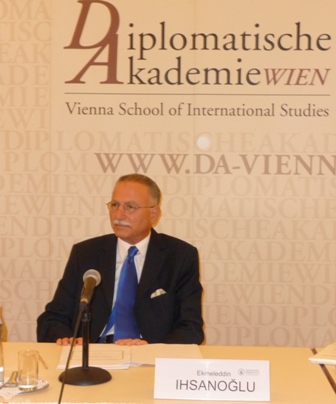 5 MAY 2010
Madame Minister, Ambassador Winkler,
Excellencies,
Ladies and Gentlemen
Having spent greater part of my professional life in academia, I feel at home with you here this evening. Thank you for bringing me back to a learning institution, and for that matter to a highly prestigious one.
I am extremely privileged to address this august assembly in this historic and highly renowned Diplomatic Academy of Vienna, reputed to have ignited the flame of knowledge, science and enlightenment since many centuries. I was delighted to know that this pioneering institution has, at one point of its history, put emphasis on language training which at the time of the Oriental Academy included Turkish, Arabic and Persian. Needless to say that these three languages were, at that era, the favoured languages of science and advanced knowledge on a global scale, and at a time when the wealth of Islamic civilization was flowing from the East in the direction of the West, in a dynamic of interconnection and transfer of science and technology that started since the twelve century.
This happy interlink between this prestigious seat of learning and the main languages of Islamic civilization induces me to talk during my address of Islamic civilization, its culture and way of life, of the Organisation of the Islamic Conference, the sole official representative of the Muslim world, of the relation between Islam and the West, and finally of the future prospective of reconciling the stands and positions of the two great civilizations, Islam and Christianity.
Ladies and Gentlemen
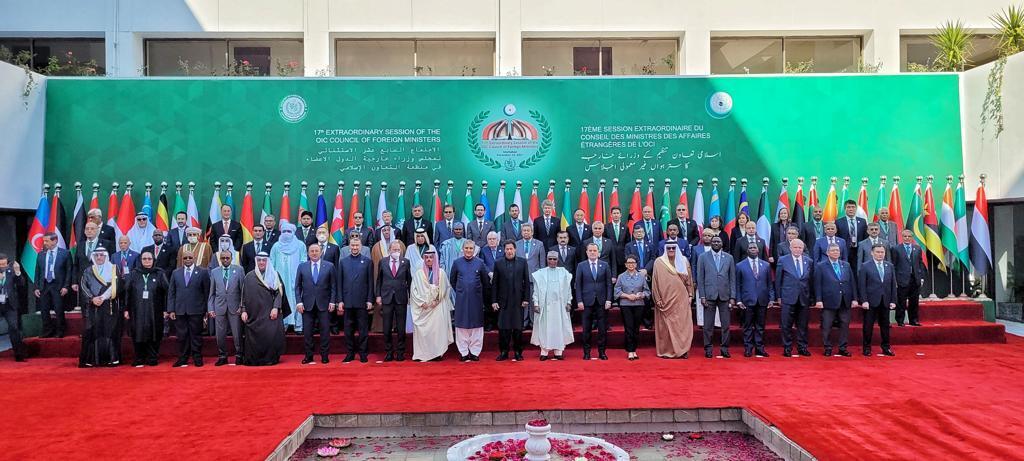
The Organisation of the Islamic Conference is an intergovernmental Organisation established in 1969 in the wake of the deep anguish felt in the Muslim world over the burning of the Holy mosque ALAKSA in Jerusalem. The OIC is the second largest intergovernmental organization after the United Nations. It is not a religious organization but one mandated to coordinate and streamline the joint Islamic action of its member states. It is also entrusted with defending the interests and the just causes of the Muslim world, and function as the only official organization that represents and speak on behalf of the Muslim world.
The concept of Muslim Ummah as a community that share destiny, commitment to common values and as a set of beliefs about life and universe is as old as Islam itself. Likewise, the feeling of belonging to this Ummah has occupied a central position in Islamic thinking throughout history, and impacted the identity of all Muslims. It was this feeling that kept the Muslim peoples, by and large, bind together under the banner of Islamic system of “Caliphate” for thirteen centuries. It ended in the aftermath of First World War when the system of Ottoman Caliphate was abolished at the start of the establishment of the Turkish Republic in 1924. The concept of Islamic solidarity, brotherhood and unity did not suffer any weakness as a result of this abolishment, because it is deeply rooted in Islamic teaching.
Nevertheless, the abolition of the Ottoman Caliphate was a shocking event for the entire Muslim world. Muslims found themselves, for the first time throughout their history facing the absence of the polity under which they lived for several centuries. The establishment of the Organisation of the Islamic Conference can be seen as the embodiment of the concept of Islamic solidarity in the contemporary world. The OIC concretized a desire, expressed since long before, to keep alive and to demonstrate Islamic solidarity or unity in a framework of a corporate international forum.
The OIC 57 member countries are spread over a large geographical region, spread out on four continents Asia, Africa, Europe, Latin America. From Albania in the north to Mozambique in the South, and from Guyana in West to Indonesia in the East. As such, the OIC countries as a group account for one sixth of the world area and more than one fifth of the total world population. The OIC member countries constitute a substantial part of the developing countries of different levels of economic developments. As a group, the OIC countries are well-endowed with a large potential of economic resources in different fields and sectors as agriculture and arable land, energy and mining, young human resources and form a vast strategic trade region. The fact that Muslim world enfolds many of the world largest fresh waterways and rivers like the river Nile, the tigress and Euphrates, the Sind and the lexus the Niger, the Senegal, makes of the agriculture commodities the primary economic activities of the OIC countries. 17 OIC countries are classified as oil exporting countries and account for a substantive percentage of the world overall oil exportations. The total population of Muslims in the world amounts to 1.67 billion in 2007, the equivalent of 23 percent of the world’s population. Given this data, the role of the OIC, since its inception was mainly geared towards directing the activities of the Muslim world countries toward consolidating the bonds of Islamic solidarity in action, through economic and cultural means, without neglecting the political aspects.
Aiming at fulfilling the Muslim world’s aspirations for development and better life and for addressing the difficult challenges of the new millennium, the heads of state of the OIC adopted a ten years programme of action in 2005 with the view to transform the OIC into a powerful entity capable of attaining these objectives. This programme provides a blueprint that encompasses all spheres of concerns to the Muslim world. It calls for collective actions to strengthen the economic cooperation among member states, to energize trade and investment, and to build capacity. It also emphasizes the urgent need to develop and upgrade the standard of higher education with a focus on science and technology. It calls for promoting human rights culture, along with democracy, good governance and the empowerment of women. In the domain of the OIC intra-trade promotion a project aiming at raising its level from 14.4% in 2004 to 20% in 2015, was adopted and a steady increase has been achieved. In 2009, this percentage has been raised to 16.65%.
So far, and over the years, the OIC and its specialized and affiliated institutions did not become a economic union of countries such as the “European Union, but it managed to give to its member states a common platform to enhance their economic cooperation in a bid to streamline their activities to the benefit of all member states.
Ladies and Gentlemen,
Human civilization is in fact one civilization, accumulated over centuries and nurtured by multitudes of tributaries across the long history of humanity. Islam was one of these tributaries which at the high time of feudalism and dark ages in Europe, Islam shined in the Middle East at the beginning of the eighth century.
The purport of the message of Islam was to ultimately bring the world out of darkness, anarchy, tyranny and oppression into the light of truth and into a new culture steeped in the principles of equality among all human beings, regardless of their ethnic origion, the colour of their skin, or social position or rank. In Islam justice was the corner stone of governance, while human right and dignity were among the strong pillars of the new faith.
Islamic teachings are situated at the middle way between divine and scholarly science, between what is material and what is spiritual. In Islam the state is not a religious states, yet it is also not purely tempular or secular. Islam is also a call to all human beings to be compassionate, responsive to all truth and goodness and morally alert in avoiding all that is evil, unjust, false and destructive
At the same time Islam was a genuine part of the whole history of religions. It continued and confirmed the previous scriptures of Judaism, Christianism and scores of other religions. It was a watershed in the history of human civilization and contributed to the rebirth of science and to bring to the fore the supreme values of tolerance, cultural diversity and the sanctity of life, and good governance.
Throughout fourteen centuries, Islam stood high, proud of its rich and generous contributions to the course of civilization. The great French thinker Jacque Berque, who was also an eminent historian and sociologist has said before his death in 1995:
“It is about time for modern Western thought to integrate Islam into its rightful context, so as not to keep it as the neglected brother or the great unknown. The Western thoughts stand to gain a lot in opening its doors to this great faith”.
In the same vein, the British/American Professor Bernard Lewis, who cannot be counted among the advocates of Islam said in one of his articles the following:
“What brought us (Islam and the West) to conflict is not our differences, but rather our resemblances: common ancestry, common backgrounds and large measure of common beliefs”.
Despite the fact that Islam was a genuine geopolitical rival to the West, Islam and Christianity were not disconnected, no more competitors. They borrowed and learned from each other whether in relation to scholarship, philosophy science, inquiry or medicine, architecture and even theology. Both of them met with the Abrahamic tradition regarding divinity, the vision of life and death and the relationship between man and the universe. As for the intellectual and knowledge base of the European personality which derives from the Hellenic heritage, no-one can deny that the Islamic civilization was the first to acknowledge this heritage, to study it, to interact with it, to digest it, to comment on it, to add to it, and to correct it where it needed to be corrected and then to disseminate it to the rest of the world, mainly to the medieval Europe.
Excellencies, Ladies and Gentlemen,
Today, Islam and the West are at a cross road in their relations, and the misunderstanding between the two remains dangerously high, mainly because of enduring tradition of distrust and fear. The West’s judgment on this relationship has been grossly distorted by taking the extreme to the norm, and by considering few Muslim fanatics as the genuine representatives of Islam. This position stands in total contradiction with what brings Islam and the West together. The European Monitoring Centre on Racism and xenophobia (EUMC) considers that “Muslims in the West have never had such an intense scrutiny placed upon them”. In its summary report, the Centre “unequivocally highlighted” the regularity with which Muslims throughout Europe became indiscriminate target for abuse and sometimes violent retaliatory attacks.
Islam was indigenous to Europe for long centuries. In Spain since the 8th century, Jews and Christian found that the encounter with Islam gave them new insight into their own religious traditions. During eight centuries of Islamic presence in Andalusia, Islamic traditions produced a unique tradition of religion and a culture of tolerance as well academic freedom unknown to the rest of Europe at that time. This fact was instrumental to propel Europe on its way to humanism and renaissance. This ideal of the Andalusia tolerance, sadly, did not survive the European history, but it did survive in Bosnia. Islam has been indigenous to East Europe for six centuries with deeply engrained tradition and six centuries of memories. In June 2007, Bosnia celebrated 600 years of Islamic tradition in the Balkan.
The current tense relation between Islam and the West brings the risk of making the notion of clash of civilizations a self-fulfilling prophesy. Islamophobia in the West constitutes two strained forums of racism, rooted in the different physical appearance of Muslims and also in an intolerance toward their religion and cultural belief. We have also inherited the descriptions of Muslims “other” from Mark Twain to Francis Fukuyama and Samuel Huntington. That has been a matter of academic intrigue as well as popular disdain often bordering on outright racism. The European Report on intolerance and discrimination against Muslims in the European Union clearly indicates that “many Westerners started to see themselves on a collision course with Muslims and Islam”.
What made this matter take a turn to the worse is that Switzerland has taken a step that made the hated Islamophobia institutionalized in its laws and constitution in the case of banning building minarets. Other countries in Europe express the intention to emulate the Swiss move. Without going into too much detail, I must add that the news emanating from this country also does not give room for comfort, as far as public discourse against Muslims and Islam is concerned.
In the middle of this confusion, I, on behalf of the Muslim world, want to appeal to the West to implement the international laws and covenants which penalize hatemongers who discriminate against Muslims and violate their human rights. We hope that Western officials will live up to their promise of embracing diversity, and stop condoning hate speech and discrimination under the guise of freedom of ex
5 MAY 2010
Madame Minister, Ambassador Winkler,
Excellencies,
Ladies and Gentlemen
Having spent greater part of my professional life in academia, I feel at home with you here this evening. Thank you for bringing me back to a learning institution, and for that matter to a highly prestigious one.
I am extremely privileged to address this august assembly in this historic and highly renowned Diplomatic Academy of Vienna, reputed to have ignited the flame of knowledge, science and enlightenment since many centuries. I was delighted to know that this pioneering institution has, at one point of its history, put emphasis on language training which at the time of the Oriental Academy included Turkish, Arabic and Persian. Needless to say that these three languages were, at that era, the favoured languages of science and advanced knowledge on a global scale, and at a time when the wealth of Islamic civilization was flowing from the East in the direction of the West, in a dynamic of interconnection and transfer of science and technology that started since the twelve century.
This happy interlink between this prestigious seat of learning and the main languages of Islamic civilization induces me to talk during my address of Islamic civilization, its culture and way of life, of the Organisation of the Islamic Conference, the sole official representative of the Muslim world, of the relation between Islam and the West, and finally of the future prospective of reconciling the stands and positions of the two great civilizations, Islam and Christianity.
Ladies and Gentlemen
The Organisation of the Islamic Conference is an intergovernmental Organisation established in 1969 in the wake of the deep anguish felt in the Muslim world over the burning of the Holy mosque ALAKSA in Jerusalem. The OIC is the second largest intergovernmental organization after the United Nations. It is not a religious organization but one mandated to coordinate and streamline the joint Islamic action of its member states. It is also entrusted with defending the interests and the just causes of the Muslim world, and function as the only official organization that represents and speak on behalf of the Muslim world.
The concept of Muslim Ummah as a community that share destiny, commitment to common values and as a set of beliefs about life and universe is as old as Islam itself. Likewise, the feeling of belonging to this Ummah has occupied a central position in Islamic thinking throughout history, and impacted the identity of all Muslims. It was this feeling that kept the Muslim peoples, by and large, bind together under the banner of Islamic system of “Caliphate” for thirteen centuries. It ended in the aftermath of First World War when the system of Ottoman Caliphate was abolished at the start of the establishment of the Turkish Republic in 1924. The concept of Islamic solidarity, brotherhood and unity did not suffer any weakness as a result of this abolishment, because it is deeply rooted in Islamic teaching.
Nevertheless, the abolition of the Ottoman Caliphate was a shocking event for the entire Muslim world. Muslims found themselves, for the first time throughout their history facing the absence of the polity under which they lived for several centuries. The establishment of the Organisation of the Islamic Conference can be seen as the embodiment of the concept of Islamic solidarity in the contemporary world. The OIC concretized a desire, expressed since long before, to keep alive and to demonstrate Islamic solidarity or unity in a framework of a corporate international forum.
The OIC 57 member countries are spread over a large geographical region, spread out on four continents Asia, Africa, Europe, Latin America. From Albania in the north to Mozambique in the South, and from Guyana in West to Indonesia in the East. As such, the OIC countries as a group account for one sixth of the world area and more than one fifth of the total world population. The OIC member countries constitute a substantial part of the developing countries of different levels of economic developments. As a group, the OIC countries are well-endowed with a large potential of economic resources in different fields and sectors as agriculture and arable land, energy and mining, young human resources and form a vast strategic trade region. The fact that Muslim world enfolds many of the world largest fresh waterways and rivers like the river Nile, the tigress and Euphrates, the Sind and the lexus the Niger, the Senegal, makes of the agriculture commodities the primary economic activities of the OIC countries. 17 OIC countries are classified as oil exporting countries and account for a substantive percentage of the world overall oil exportations. The total population of Muslims in the world amounts to 1.67 billion in 2007, the equivalent of 23 percent of the world’s population. Given this data, the role of the OIC, since its inception was mainly geared towards directing the activities of the Muslim world countries toward consolidating the bonds of Islamic solidarity in action, through economic and cultural means, without neglecting the political aspects.
Aiming at fulfilling the Muslim world’s aspirations for development and better life and for addressing the difficult challenges of the new millennium, the heads of state of the OIC adopted a ten years programme of action in 2005 with the view to transform the OIC into a powerful entity capable of attaining these objectives. This programme provides a blueprint that encompasses all spheres of concerns to the Muslim world. It calls for collective actions to strengthen the economic cooperation among member states, to energize trade and investment, and to build capacity. It also emphasizes the urgent need to develop and upgrade the standard of higher education with a focus on science and technology. It calls for promoting human rights culture, along with democracy, good governance and the empowerment of women. In the domain of the OIC intra-trade promotion a project aiming at raising its level from 14.4% in 2004 to 20% in 2015, was adopted and a steady increase has been achieved. In 2009, this percentage has been raised to 16.65%.
So far, and over the years, the OIC and its specialized and affiliated institutions did not become a economic union of countries such as the “European Union, but it managed to give to its member states a common platform to enhance their economic cooperation in a bid to streamline their activities to the benefit of all member states.
Ladies and Gentlemen,
Human civilization is in fact one civilization, accumulated over centuries and nurtured by multitudes of tributaries across the long history of humanity. Islam was one of these tributaries which at the high time of feudalism and dark ages in Europe, Islam shined in the Middle East at the beginning of the eighth century.
The purport of the message of Islam was to ultimately bring the world out of darkness, anarchy, tyranny and oppression into the light of truth and into a new culture steeped in the principles of equality among all human beings, regardless of their ethnic origion, the colour of their skin, or social position or rank. In Islam justice was the corner stone of governance, while human right and dignity were among the strong pillars of the new faith.
Islamic teachings are situated at the middle way between divine and scholarly science, between what is material and what is spiritual. In Islam the state is not a religious states, yet it is also not purely tempular or secular. Islam is also a call to all human beings to be compassionate, responsive to all truth and goodness and morally alert in avoiding all that is evil, unjust, false and destructive
At the same time Islam was a genuine part of the whole history of religions. It continued and confirmed the previous scriptures of Judaism, Christianism and scores of other religions. It was a watershed in the history of human civilization and contributed to the rebirth of science and to bring to the fore the supreme values of tolerance, cultural diversity and the sanctity of life, and good governance.
Throughout fourteen centuries, Islam stood high, proud of its rich and generous contributions to the course of civilization. The great French thinker Jacque Berque, who was also an eminent historian and sociologist has said before his death in 1995:
“It is about time for modern Western thought to integrate Islam into its rightful context, so as not to keep it as the neglected brother or the great unknown. The Western thoughts stand to gain a lot in opening its doors to this great faith”.
In the same vein, the British/American Professor Bernard Lewis, who cannot be counted among the advocates of Islam said in one of his articles the following:
“What brought us (Islam and the West) to conflict is not our differences, but rather our resemblances: common ancestry, common backgrounds and large measure of common beliefs”.
Despite the fact that Islam was a genuine geopolitical rival to the West, Islam and Christianity were not disconnected, no more competitors. They borrowed and learned from each other whether in relation to scholarship, philosophy science, inquiry or medicine, architecture and even theology. Both of them met with the Abrahamic tradition regarding divinity, the vision of life and death and the relationship between man and the universe. As for the intellectual and knowledge base of the European personality which derives from the Hellenic heritage, no-one can deny that the Islamic civilization was the first to acknowledge this heritage, to study it, to interact with it, to digest it, to comment on it, to add to it, and to correct it where it needed to be corrected and then to disseminate it to the rest of the world, mainly to the medieval Europe.
Excellencies, Ladies and Gentlemen,
Today, Islam and the West are at a cross road in their relations, and the misunderstanding between the two remains dangerously high, mainly because of enduring tradition of distrust and fear. The West’s judgment on this relationship has been grossly distorted by taking the extreme to the norm, and by considering few Muslim fanatics as the genuine representatives of Islam. This position stands in total contradiction with what brings Islam and the West together. The European Monitoring Centre on Racism and xenophobia (EUMC) considers that “Muslims in the West have never had such an intense scrutiny placed upon them”. In its summary report, the Centre “unequivocally highlighted” the regularity with which Muslims throughout Europe became indiscriminate target for abuse and sometimes violent retaliatory attacks.
Islam was indigenous to Europe for long centuries. In Spain since the 8th century, Jews and Christian found that the encounter with Islam gave them new insight into their own religious traditions. During eight centuries of Islamic presence in Andalusia, Islamic traditions produced a unique tradition of religion and a culture of tolerance as well academic freedom unknown to the rest of Europe at that time. This fact was instrumental to propel Europe on its way to humanism and renaissance. This ideal of the Andalusia tolerance, sadly, did not survive the European history, but it did survive in Bosnia. Islam has been indigenous to East Europe for six centuries with deeply engrained tradition and six centuries of memories. In June 2007, Bosnia celebrated 600 years of Islamic tradition in the Balkan.
The current tense relation between Islam and the West brings the risk of making the notion of clash of civilizations a self-fulfilling prophesy. Islamophobia in the West constitutes two strained forums of racism, rooted in the different physical appearance of Muslims and also in an intolerance toward their religion and cultural belief. We have also inherited the descriptions of Muslims “other” from Mark Twain to Francis Fukuyama and Samuel Huntington. That has been a matter of academic intrigue as well as popular disdain often bordering on outright racism. The European Report on intolerance and discrimination against Muslims in the European Union clearly indicates that “many Westerners started to see themselves on a collision course with Muslims and Islam”.
What made this matter take a turn to the worse is that Switzerland has taken a step that made the hated Islamophobia institutionalized in its laws and constitution in the case of banning building minarets. Other countries in Europe express the intention to emulate the Swiss move. Without going into too much detail, I must add that the news emanating from this country also does not give room for comfort, as far as public discourse against Muslims and Islam is concerned.
In the middle of this confusion, I, on behalf of the Muslim world, want to appeal to the West to implement the international laws and covenants which penalize hatemongers who discriminate against Muslims and violate their human rights. We hope that Western officials will live up to their promise of embracing diversity, and stop condoning hate speech and discrimination under the guise of freedom of ex